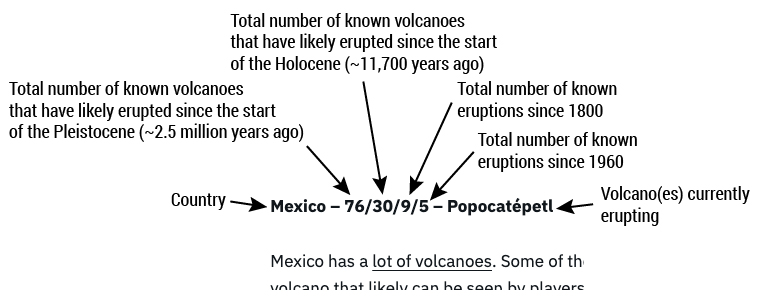
As we start the 2026 Volcano World Cup I wanted to give everyone a primer in how to read the country information you will see across the competition. Think of it like the chyron used when a batter steps to the plate in baseball — it has all the important information you might need to understand how good/not good the batter’s performance is.
In my example above for Mexico, there are 4 numbers. All of these counts are derived from the Smithsonian/USGS Global Volcanism Program’s database of volcanism. From left to right they are:
- Total number of known volcanoes that have likely erupted over the past ~2.5 million years (the Pleistocene in geologic parlance). There is a lot of slop in this number because 2.5 million years is a long time but not necessarily long enough for some volcanic systems to be considered truly extinct. Think of this like the “big picture” volcano score for the country.
- Total number of known volcanoes that have likely erupted over the past ~11,700 (the Holocene). This represents activity since the end of the last Ice Age (more or less) and is a pretty good indicator of volcanoes that should be considered “potentially active”. This number is the active potential for a country.
- Total number of known eruptions since 1800. Here is where the numbers change meaning. While the first two speak to the overall potential and extent of volcanism in a country, this number (and the next) are about production. Now, this value is likely a low-end estimate for volcanically active places as we have likely missed a multitude of small eruptions, but it does give us a good idea of just how active a country’s volcanoes might be.
- Total number of known eruptions since 1960. This is where the rubber meets the road. People think about this recent activity when considering the volcanism in a country. The Cascades and Kamchatka are both active volcanic arcs but since 1960, Kamchatka is much more active.
Finally, the name(s) listed at the far right are volcanoes considered to be in active eruption (as defined by the Global Volcanism Program). This is the here and now.
A Quick Note About Who Makes It Through
The real 2026 World Cup has expanded the number of countries that qualify to 48 divided into groups of 4. That is 12 groups. Now, if you are someone familiar with tournament brackets, that doesn’t make for an easier pass through to get to a single winner. So, here is how I (and FIFA) are working it:
- The top 2 vote getters (by %) move to the knockout rounds. That gives us 24 teams.
- To get to 32 teams (the ideal for a bracket tournament) we still need 8 teams. So, the top 8 vote getters (by %) across all 12 groups will move on.
- The seeding will also work like FIFA, where the the highest seed overall plays the lowest provided they are not in the same initial group. However, the bracket will not reseed after the first knockout round.
- After the round of 32, we’ll get down to 16, then 8, then 4, then the championship.
- Yes, it is complicated.

 ERUPTIONS
Leave a comment