It isn’t often that we get a clear day across much of Russia’s Kamchatka Peninsula. February 15, 2026 was one of those rare days and ESA’s Sentinel-2 had clear shots of so many volcanoes! So, in honour of such a nice day (although I imagine it was bitterly cold to be that clear in February), here is a clear tour across one of the most active volcanic arcs on Earth.

We’ll start with the sort of not volcano. This promontory into the Pacific Ocean is Gora Nachikinskaya. It sure looks volcanic but likely hasn’t been active for hundreds of thousands of years to millions of years. Maybe it is extinct? It is one of those volcanoes about which we just don’t know much. How little do we know? Well, it doesn’t seem to have any Global Volcanism Program entry.

On the other end of the spectrum and somewhat nearby is Shiveluch, a volcano that is erupting right now. This image shows some light grey ash on the snow and a small white steam/gas plume in the crater. The horseshoe shape of the volcano is thanks to a massive collapse it experienced in 1964 much like Mount St. Helens in 1980.

I included these two older volcano mostly because of the contrasting landscapes. Kharchinsky (upper) and the horseshoe shaped Zarechny (lower) both likely haven’t erupted in tens of thousands year. The river at the bottom is the Kamchatka River — which is free of ice! Some of the more distant deposits from Shiveluch are seen in the upper right.

This cluster known as the Klyuchevskoi Volcanic Group is one of the most famous on the peninsula. It features no less than 7 potentially active volcanoes in an area roughly half the size of Rhode Island. I’ve subdivided these into the next few images, but this might be some of the densest clustering of active volcanoes on the planet today.

Zooming in on the south we see Tolbachik (with the summit crater lake), Udina to its lower right and Zimina to the upper right of Udina. Tolbachik is the most impressive of the bunch because with the white layer of snow, the line of cinder cones heading to the southwest (lower left) of the volcano stands out. In fact, it is two overlapping volcanoes: Plosky Tolbachik to the right and Ostry Tolbachik to the left. Plosky Tolbachik has a nested crater at its summit, with the most recent activity from the summit coming from the most obvious crater. The 2013 and 1976 eruptions from the volcano were from the rift zone below the main edifice, with the latter being the largest known basaltic eruption on the Kamchatka Peninsula.
As for Udina and Zimina, Udina has no known historical eruptions but likely has erupted in the last few thousand years while Zimina is older and likely hasn’t erupted for many thousands to tens of thousands years.

The northern half of the cluster has three big volcanoes (Kamen, Klyucheskoi and Ushkovsky) and one smaller one that makes up for it by being very active (Bezymianny). The volcano with the nested calderas and craters on the left is Ushkovsky. As you might guess, Ushkovsky is actually overlapping volcanic systems that includes lava flows, cinder cones and collapse calderas (much like Tolbachik). Its last confirmed eruption was in 1890.
The two peaks in the lower right side — marked by the triangular shadows — are Kamen (lower) and Klychevskoi (upper). This whole cluster is named after Klychevskoi and it deserves it, being the tallest and most active of the Kamchatka volcanoes. Its most recent eruptions ended in August 2025. Kamen has likely erupted in the past 10,000 years but has also experienced some major collapses including one about 1,200 years ago that took out much of the volcano.
Finally, Bezymianny, like Shiveluch, is highly active and experienced a partial collapse like Mount St. Helens. You can see the horseshoe-shaped crater in the middle-bottom of the image. Bezymianny itself started erupting about 4,700 years ago and in this image you can see a thin streak of grey ash extending from the volcano to the east (left) across the snow.

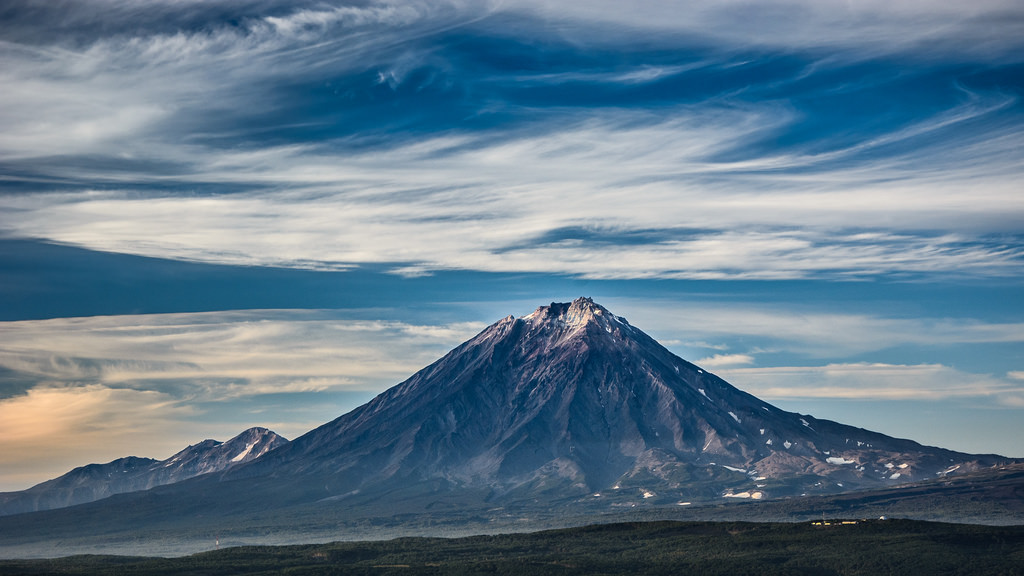
Peaking through the clouds here is Kizimen, about 75 kilometres south of the Klyuchevskoi Group. On the right side of the volcano you can see an impressive lava flow with levees partially hidden by these wispy clouds. It was active from 2010-13, its first know activity since the 1920s.

This shot pulls out from Kizimen (which can be seen on the left in the bank of clouds.) Just to the right of Kizimen is Konradi while the volcano with the horseshoe shaped crater below Konradi near the bottom of the shot is Schmidt. In fact, the ridges leading to the upper right from Kizimen and Schmidt are home to no less than 9 volcanoes, albeit some of which may not have been active for a million years.

Just to the south of Schmidt and north of Krasheninnikov is Kronotsky. It has some young looking lava flows on its slopes. The last dated eruption from Kronotsky was over 5,000 years ago but some fumaroles still persist on the volcano. An ice-covered Lake Kronotsky is just off to the left.

Krasheninnikov famously reawakened just after the M9 Kamchatka earthquake in November 2025. In this shot, the wide (~10 km!) caldera of Krasheninnikov is clear with the more recently rebuilding of the volcano with the caldera quite evident. The black smear on the upper slopes is the recent lava flows that continue to erupt from the volcano. Prior to last year, the last eruption might have been as far back as 1550. Kronotsky can be seen in the upper right.

Yet another cluster of volcanoes! At the bottom is the complicated caldera system of Bolshoi Semiachik. Due north (above) is the more subtle caldera of Uzon. Flanking Uzon are Taunshits (left) and Kikhpinych (right). Bolshoi Semiachik features yet another ~10 kilometre caldera that is now filled with domes that have formed over the last 10,000 years or more. Uzon is actually multiple calderas included Geysernaya. As that name might imply, there are geysers and hydrothermal features all throughout this part of Kamchatka. Uzon likely last erupted around 200 CE. Taunshits may have last erupted around 550 CE while Kikhpinych is the youngest volcano in the Eastern Kamchatka Volcanic Zone with eruptions potentially as recently as 1550 and 1350 (VEI 3 and 4). You can see lava flows on the eastern slopes (right side) of Kikhpinych.

Just to keep us on our toes, the next volcano is Maly Semyachik (not to be confused with Bolshoi Semiachik). Maly Semiachik has a 10 kilometer caldera that sits in an older ~20 kilometre caldera! The twin craters at the summit of the volcano are the source of the most recent eruptions (as recently as 1952) although the left crater tends to be filled with a crater lake.

Karymsky is one of the more active volcanoes in Kamchatka these days. The volcano looks like a dollop of lava flows filling an older caldera (that may have formed less than 10,000 years ago). Even though its last eruptive period ended in September 2025, you can convince yourself of a dusting of ash on the uppermost slopes of Karymsky.

Due south of Karymsky is another — you guessed it — caldera. A lake fills the Akademia Nauk caldera, the youngest of three within this complex system. It likely formed about 30,000 years ago. It last erupted in 1996 from the north side of the lake.

From here we jump down to the twin volcanoes of Dzenzursky (left) and Zhupanovsky (right). To me, the most impressive features here are the long andesite lava flows from vents between the two volcano that show levees (parallel to the flow) and pressure ridges (perpendicular to the flow). These flows look young but are likely thousands of years old. Zhupanovsky has been active much more recently, with a series of eruptions between 2013-2016.

Off to the west of Zhupanovsky and Dzenzursky is a small volcano called Zavaritsky. It caught my eye thanks to some impressive lava flows draping the slopes. These lava flows blocked a couple of rivers in the region about 2,800 year ago.

Another trio! Starting in the bottom middle and moving to the upper left, we have Avachinsky, Koryaksky and the most eroded Aak. Avachinsky is highly active and one of the few Kamchatka volcanoes with a significant population within reach. Over 300,000 people living the greater Petropavlovsk area live within 100 kilometres of Avachinsky. Although it hasn’t erupted since 2001, it did produced two VEI 4 eruptions during the 20th century. Koryaksky is a little further from Petropavlovsk and a little less active than Avachinsky, but more recently active with an eruption in 2008. Finally, Aak (a fabulous name) is much older and likely hasn’t erupted for tens of thousands years or more.

Just to the south of Petropavlovsk is Vilyuchinsky, one of the volcanoes closest to the Pacific Ocean. Although it looks symmetrical and conical, it is actually heavily eroded and hasn’t erupted for over 10,000 years.

Guess what? Another cluster. Smack in the middle of this shot is Gorely, a composite volcano growing within an older caldera. To the lower right is Mutnovsky and off to the left of Gorely is Tolmachev (more on that in another shot). Gorely is actually a group of domes and vents within a ~13 kilometre caldera. Gorely has a small eruption from its summit in June 2010 but its last major was in 1980-81. Mutnovsky hasn’t erupted since 2000, but prior to that it was one of the most active volcanoes in Kamchatka with numerous eruptions over the past couple hundred years.

I separated out Tolmachev (or Tolmachev Dol) not because it is highly active but rather because I love the lava dome in this shot. In the middle left is a squat dome fanning out from a scoria cone in its center. It really stands out against the ice-covered surface of the lake. Other scoria cones and maars (formed by water and magma interacting to create explosions) can be seen on the left side of the shot as well. The most recent activity at Tolmachev Dol was around 300 CE.

In this shot you can still see some of cones from Tolmachev Dol on the right but right up against the cloud bank is Opala. Down at the foot of the volcano is a small dome complex. It is a little hard to see in this shot but Opala sits within a ~14 kilometre caldera that is ~40,000 years old. The most recent confirmed eruption was in 1776 but a rhyolite eruption in ~550 CE was a VEI 5 — the same scale as Mount St. Helens 1980.

If we head to the southeast of Opala we reach Asacha, another set of overlapping volcanoes surrounded by scoria cones. There aren’t any known eruptions at Asacha, but it has likely erupted in the past million years.

Further south as we begin to transition from the Kamchatka arc to the Kuril Island arc is Khodutka. In the summer, the red complexion of its slopes are evidence but in winter you can see the conical shape to the volcano clearly. Although you could be tricked into thinking it is youthful, Khodutka’s last confirmed eruption was in ~350 BCE. However, don’t take the volcano lightly. In ~930 BCE it produced a VEI 5 explosive eruption that blanketed the region in ash and potentially had another VEI 4 a little over 100 years before that.

We’re almost done, I promise! Just to the west of Khodutka is the Olkoviy Volcanic Group. I just liked the multitude of scoria cones across this flat region, somewhat like the area near Newberry Caldera in the Cascades. The most recent activity here was likely within the past 10,000 years.

It began to get a little cloudier in the southern end of the peninsula — only ~650 kilometres to the south! This caldera with a small cloud covering its caldera lake is Ksudach. It is actually five overlapping caldera. The volcano has produced no less than five VEI 5+ eruptions over the past 10,000 years, including a VEI 6 (Pinatubo-scale) in ~240 CE. Interspersed are a whole bunch of smaller VEI 3-4 eruptions as well. The most recent confirmed eruption was a VEI 5 in 1907.

Now really peaking through the clouds in Kurile Lake. It is — you guessed it — another caldera. Although it hasn’t been historically active, its one known eruption that occurred around 6,400 BCE was a doozy – a VEI 7! That puts it up there with the ~7,700 year old Crater Lake eruption in the Cascades. If you can believe it, Kurile Lake sits next to an even bigger caldera system (Pauzhetka) that is a ~25 kilometre caldera that formed ~443,000 years ago.
It is hard to top that — and the clouds seem to know it. Although there are more volcanoes on Kamchatka south of Kurile Lake, they weren’t out for viewing. I hope you enjoyed this tour of some of Kamchatka’s volcanoes — and yes, there are many more!
 Eruptions
Leave a comment